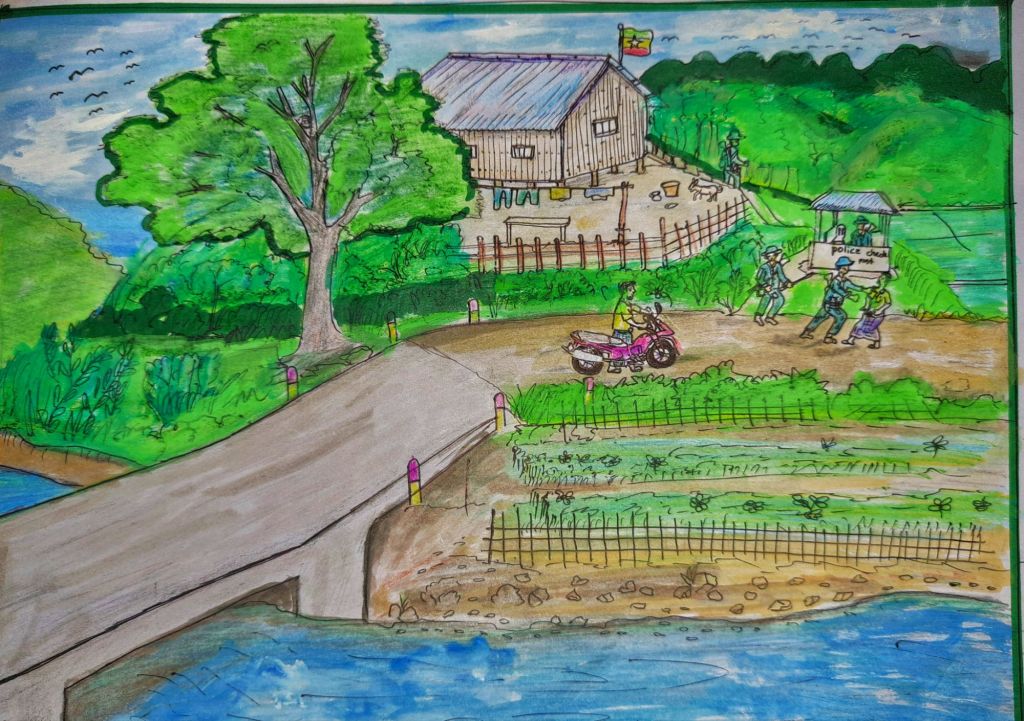
By Auwar Sadek
The earth itself claims that It is impressively decorated with its natural scenery, the humanity in human beings and beautiful countries. A country called Myanmar is a part of geographical Eastern land on Map, including 136 ethnicities. One them is Rohingya minority living along the Arakan State, western side of Myanmar, combining with Rakhine people.
Maungdaw, Buthidong and Rathidong are the towns of Arakan with mostly Rohingya Muslims, restricted heavily by the Government of Myanmar to prevent Rohingya from the freedom with the installation of so many check points among their villages which they used to check the innocences and made them push their vehicles after climbing down. Is there any country in the world whose government forcing the public to push thier vehicles like bikes and cycles while they cross the check points in the main roads?
In Myanmar, the BGP and police forces forced Rohingya people to get off their bicycles and motorbikes while crossing checkpoints. However, Rakhine people using the same route and passing through the same checkpoints were not subjected to this treatment, they were allowed to continue without being stopped or forced to dismount. This clearly reflects an intentional and discriminatory policy by the Myanmar authorities, targeting Rohingya Muslims and subjecting them to humiliation and unequal treatment.
No one was exempt including students, businessmen and ordinary civilians. “They also confiscated money and other valuables from businessmen, shopkeepers and fish sellers.” Nurul Amin said, “If anyone refused to meet their demands, he or she was punished and all their belongings were seized.”
Sometimes, innocent people were falsely accused and called into their rooms for interrogation and intimidation. Women were also targeted and subjected to secret abuse and rape in these rooms. “Rohingya students were not spared from their brutal treatment; they too were forced to get off their bicycles and motorbikes while crossing the checkpoints.” Nurul Amin added.
” For example, I was a student when I lived in Myanmar. My village was six miles away from my school, and I had to cross the checkpoints to get there. Shockingly, within that six-mile distance, there were six checkpoints.” Mohammed Jubair explained, ” I had to pass through each one just to attend school. I was also constantly afraid, as the Myanmar BGP could falsely accuse me of any issue, even if I had nothing to do with it.”
Every checkpoint was a struggle for every Rohingya civilian, was forced to get off thier bicycle and push it while crossing each one.
At every checkpoint, every Rohingya was required to show a permission slip issued by the village administrator. If they were unable to show it, they were either forcibly punished or sent back to their village.
Rohingya Muslims have endured these forms of hardship and discrimination in their own land since the day they were born. Because of limited access to social media and the internet, these struggle voices went unnoticed by the outside world. The Myanmar government systematically enforced these measures as part of a silent campaign to erase the Rohingya from their ancestral homeland.