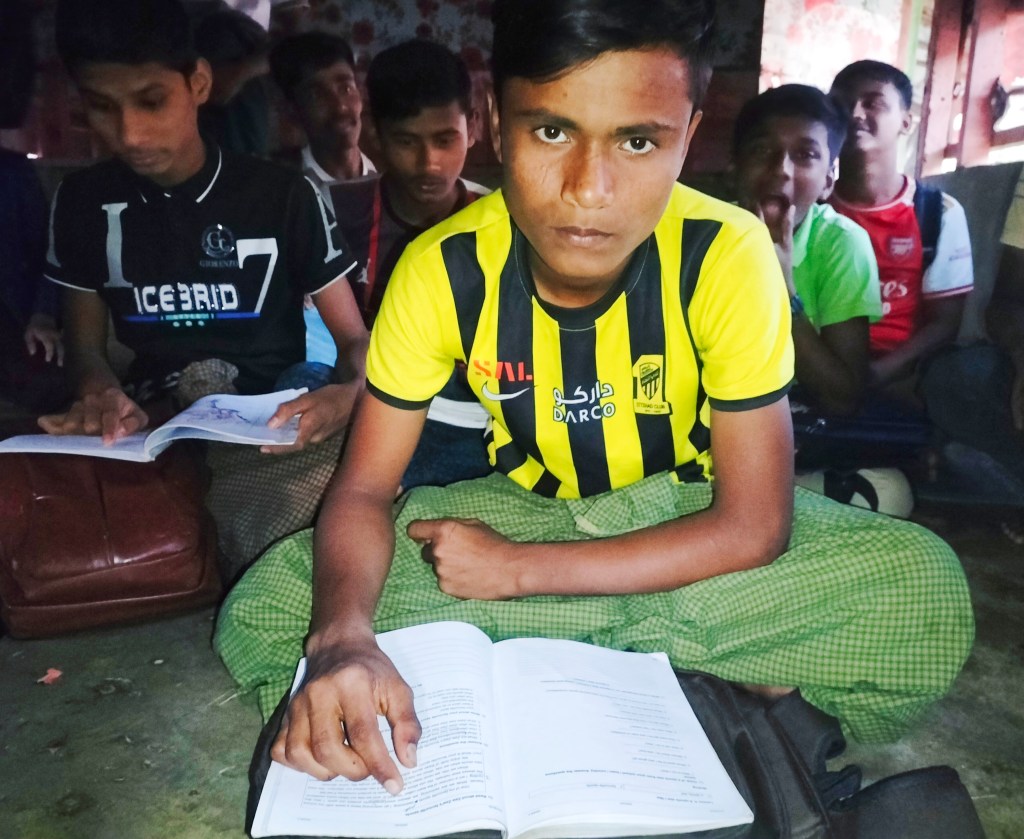
Photo captured by Ayub Khan Dkl during Rohingya young students are demanding the protection from the international bodies
The denial of the Myanmar government has left the Rohingya people deeply concerned as they mark the 8th anniversary of the 2017 atrocities, still holding on to the hope of a dignified return to their ancestral homeland.
Since the country’s independence in 1948, the Myanmar government has systematically excluded the Rohingya from their ancestral lands, stripping them of rights and recognition. Over decades of gradual persecution and orchestrated violence, more than one million innocent Rohingya civilians were forced to flee into neighboring Bangladesh. How can a person survive without land, peace, and dignity? For the Rohingya, 25 August 2017 stands as a dark milestone, the day everything they owned and cherished was destroyed.
Despite living in disorderly, overcrowded refugee camps made of mud and tarpaulin shelters in Cox’s Bazar, Bangladesh, the Rohingya community has not remained silent. They continue to raise their voicesfor justice and equal rights that were unjustly stolen by Myanmar Government.
“We will never stop raising our voices until our rights are restored,” said Sarwah Shah, 22, a Rohingya youth. “We will never let the Myanmar government or the Arakan Army take advantage of our people and our motherland, Arakan State.”
Eight years have passed, yet the international community has failed to bring justice. Mohammed Ayub, 32, a Rohingya activist, reflected:
“Behind every 25 August lies a drop of tears and heartbreak. It reminds us of our sisters being raped, our children thrown into fire, and our homes burnt by the Myanmar military.”
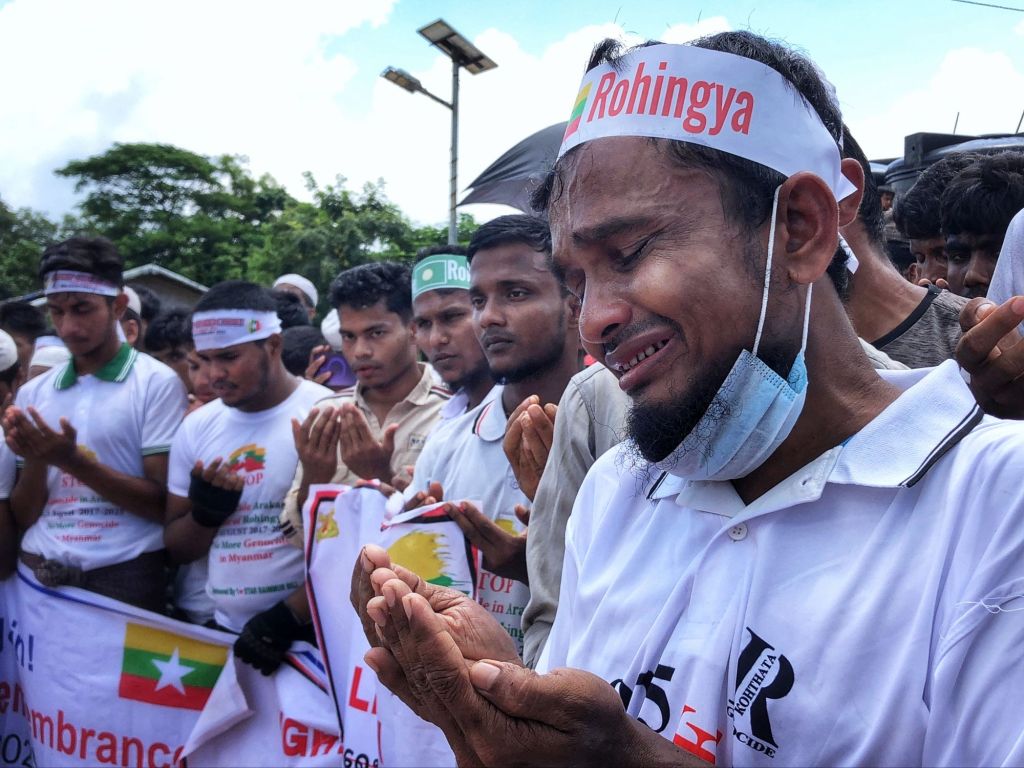
Photo captured by Ayub Khan Dkl, showing Rohingya survivors in tears as they prayed on stage during the 8th Anniversary of Rohingya Genocide Rememberance Day
Ayub also added that to delay justice is not only to ignore genocide but also to silently support the perpetrators in their crimes.
At the same time, the Arakan Army (AA), a Rakhine rebel group has become another source of suffering for the Rohingya, falling like a sudden stone from the sky. While their stated aim is to challenge the Myanmar military, their violence has heavily targeted on innocent Rohingya civilians. Torture, rape, killings, looting, and land seizures have become widespread.
Anuwar Faisal, a private teacher who fled to Bangladesh in 2024, described that the year ” 2024 ” is the worst period in recent memory of Arakan State.
“The Arakan Army conscripted our youths to use them as human shields on the frontlines. They killed more than 5,000 civilians with drone attacks. It was unforgettable.”
For decades, Rohingya Muslims have been denied citizenship by the Myanmar government, effectively confering them stateless. The continued delay in addressing this crisis by the international community only strengthens the hands of the perpetrators and deepens the suffering of the victims.
The Rohingya community urges that silence is no longer an option. The international community must act decisively to end impunity, restore rights, and ensure a just and dignified return for one of the world’s most persecuted peoples like Rohingya.
My name is Abul Kayes, and I was born on July 2, 2002, in a village called Yea Mea Toung, nestled in the green hills of Northern Maungdaw, in Arakan State, Myanmar. My family is big with my parents, four brothers, eight sisters, and me. We lived a life of simplicity and closeness, where love was stronger than hardship. My father, Nur Korim, now 73, is a man of deep thought and quiet strength. My mother, Sara Khatun, now 48, is the heart of our home, resilient, selfless, and full of courage.
Our village was more than a place. It was a world. I remember waking up to the sounds of birds and the smell of fresh rain within the romantic scene as I felt like a prince in a kingdom made of bamboo, sunlight, and family.
But on 25 August 2017, when I was just 15, everything changed. The sound of gunfire from the Burmese military thundered over the skies like crashing icebergs, shattering the calm and scattering our world into trauma. I remember the fear before I understood the reason. Rumors of violence spread like wildfire: soldiers were coming. Villages were burning. People were disappearing. And then, it came to us. That night, none of us could sleep. All of my parents’ remaining belongings including jewelry were buried under the ground for safety. My mother held onto 500,000 MMK, but it didn’t last. Some of it was spent during our escape, and the rest was given to the poor as an act of generosity even in hardship. My father quickly reached out to his brother, Habib Ullah, who supported us by sending 100,000 MMK after selling fish from my father’s lagoon.
One night, under a moonless sky, we packed whatever we could carry that were some rice, clothes, and food. Before leaving, we fed our cows and pets, hoping they’d survive without us. But they didn’t touch the food. They seemed to know. We cried as we walked away from everything we had ever known.
On 27 Aug 2017, we made our way to Kyet Yoe Pyin ( ကြက်ရိုးပြင် ) where one of my sisters lived. Her family joined our escape. Along the way, we lost Jesmin, my sister, in the chaos. She had run ahead. It took hours to find her in a nearby village. By then, our home had burned to ash.
We moved another village called Kiyan Bong where we took shelter but sometimes we needed to sleep beside the village, in the paddy fields and hidden inside the bushes because the fear of Militaries’ gunshots didn’t allow to stay at proper place or sleep. My mother had cooked Qurbanimeat for Eid just the day before we fled. “It is our last proper meal as a family.” My mother said with tear.
We again reached Shil Khali village. I remember carrying 2–3 kilograms of rice and the last 2,000 kyat we had. I bought onions and chilies from a nearby shop. Jesmin made a thin soup that warmed our empty stomachs and tired souls.
On 3 Sep 2017, we crossed the Naf River into Bangladesh, but a new challenge awaited us. The boats were too small to carry our entire family together, so I and one of my brothers boarded one boat, while the rest of our family, including my parents, were placed on another.
During the crossing, the crew on our boat took everything we had important documents, supplies, and personal belongings. It was a cruel moment when we were already at our most vulnerable. Thankfully, the rest of the family had managed to carry 100,000 MMK which my Uncle sent to my parents and paid the fare for their boat.
We arrived on the other side with exhausted, broken, and afraid hearts. But then something unexpected happened. The Bangladeshi people welcomed us with kindness. They gave us water, food, and shelter. For the first time in weeks, we felt the warmth of human compassion again.
Jesmin got lost once more in Hansur Para, a village in Bangladesh, waiting on the roadside. When we finally found her, we smiled. It was the first smile I’d seen on my parents’ faces since we left Myanmar. We stayed there for three days, then moved to Kutupalong Refugee Camp in Cox’s Bazar, now the largest refugee settlement in the world. My eldest sister’s husband paid the 2,500Tk for our transport. It wasn’t easy, but we were safe.
My parents, even in their grief, encouraged me to keep studying. I enrolled in informal classes and managed to complete Class 10 while living in the camp. It was not just about education and it was survival. Learning became my rebellion.
My mother, with almost nothing, found ways to support me. She sold lentils, rice, and potatoes, earning barely 500 taka a month, just enough for pens and notebooks. Her hands were worn, but her faith was unshaken. ” You don’t need to be afraid of your study is being lost till I am alive.” She encouraged me
I also studied Arabic and Urdu on my own. I wanted to speak with dignity, to write with power. Every new word I learned felt like reclaiming something the world tried to take from us.
When I was 16, I met a man named Soyed Korim. He told me to write a CV, a simple piece of paper that would change my life. I applied for a job, and by the mercy of Allah, I was hired as a Case Management Volunteer with CODEC on November 6, 2019.
It was the first time I felt I had a role in the world again. Since then, I’ve worked to help other refugees, children like me, families like mine, who lost everything but hope. Life is still hard. Our salaries are small. We fall sick often. But we are human, and we still dream. We still believe
This story is not just mine. It is the story of the Rohingya people, a story of sorrow, strength, and survival. We were born in a storm, but we are not broken.
“Hope grows in the soil of pain. And education is the light that breaks through the darkness.”
My parents once dreamed I would become a surgeon. Today, I dream of studying at Stanford University. I don’t know what tomorrow holds. But I know that I will keep learning. I will keep helping. I will keep dreaming. of Because we may be refugees in the eyes of the world. But in the eyes of Allah, we are not forgotten.
Note:
Abul Kayas recieved the recent writing workshop and begins writing on real stories including his own one.
We are proud of seeing our Beginning Writer’s Workshop is playing an essential part of growing too many talents.
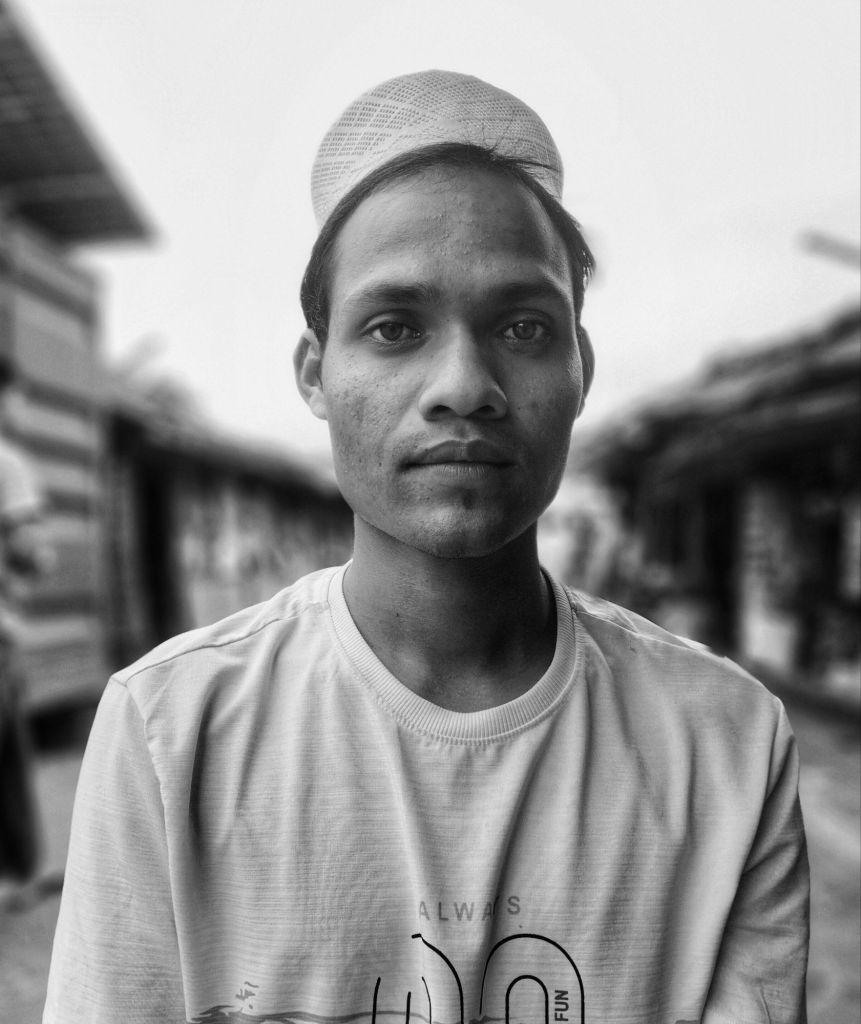
Nurul Amin, 17 years old, son of Sayed Nur from Kamaung Seik, Northern part of Maungdaw, Arakan State in Myanmar. In 2017, Amin along with his parents left his homeland due to a horribly genocidal act on the Rohingya minority conducted by the brutal Burmese Militaries and arrived at Kutupalong, the largest refugee camp in Bangladesh.
” In Myanmar, when I was a child, I attended to a primary school in my village and It was the most challenging period for me as the school was so far from my house and it took me hours to reach at it. During rainy days, I was completely wet while I was on the way of my school. However, I hardly managed class 2 in my homeland before 2017.” Nurul Amin claimed
In 2017, the raping, discrimination, torturing, killing innocents, throwing children into fire, burning the houses and so on operated by the Burmese militaries forced over 1 million Rohingya people from their homes and fled to a bordering country, Bangladesh and took refuge in the forests of Cox’s Bazar and Teknaf. “ My legs became disable and unable to walk on while we were crossing the mountains, villages, barbed fence and river on Aug 2017.” Amin added.
Many elderly people and young children endured unbearable struggle to find a peaceful life on those days, leaving the homes. On their way of Bangladesh, they fought starvation as they took nothing from their homes.
“ It took us two days to travel through the hills for reaching Bangladesh and had nothing to eat and sometimes we needed to pinch our stomachs to relieve the suffering of hunger.” Amin expressed
After being a refugee in the largest refugee camp, Cox’s Bazar, he became a dreamless boy and received no opportunity to continue his study. With guidelines regarding learning forced him toward useless and wasted his time without doing anything for years. Finally, his father, Sayed Nur has open a small shop near his shelter and it starts working for the entire family. “ At the last, my father made me a shopkeer and selling it every morning and evening.” Amin said
” When I was 15, one opportunity from the Life Destination High School offered me to continue my educational journey and I have been attending the class from grade-3 since 2023. It is the hope and building a dream to catch my destination through this learning platform.” He added
There are many young Rohingya children who have no opportunities to make their life and build their future by studying in the Rohingya refugee camp. Offering a formal educational opportunities bring the peace and successes in which people can enjoy their lifetime and make the community develop. The international community must focus to restore the higher education for the Rohingya students in Refugee camp, Bangladesh.
This is Mohammed Omair, 15 years old, son of Eman Hussian, a student of Life Destination High School in Refugee Camp, from Mrauk Taung Village, northern part of Maungdaw, Arakan State in Myanmar. He left his motherland, Myanmar and fled to Bangladesh to escape from the horrible second-wave of genocidal attacks carried out by the Arakan Army ( AA ). These massive weaponries cleaned all the Rohingya residents from the entire Buthidong and Maungdaw Townships and forcibly abducted Rohingya youths and used them in the front line in the battle fields. Omair along with his family crossed the Naf River and arrived at Refugee Camp in Bangladesh.
According to the various ground sources, the Rohingya muslims in Arakan State, Myanmar have been enduring the sufferings of starvation, serious illness and restricted movement and the constant fear of abduction by the Arakan Army AA and the Burmese Junta since the outbreak of their deadly conflict.
“ Since the violence has horribly been intensifying along the northern part of Maungdaw due to the terrorist Arakan Army AA and the Burmese Militaries, every cost of the basic needs like rice, oil, fish, meat, medicines and etc has increased and many of us survived without eating anything and the fight against the hunger and serious illness were also increased.” Omair explained
“ He further shared, “ Youths between 12 and 50 are the most afraid of being forcibly abducted by both parties so called the terrorists Arakan Army AA and the Junta.”
Omair left his home country, Myanmar, twice by the age of 15, in 2017 and 2024. In 2017, the widespread torture, masscares, rapes, throwing children into the fire, discrimination and other atrocities commited by the Burmese brutal Militaries and the Rakhine Rebel group forced over one million Rohingya to flee their country. Omair and his family were among those who fled, taking refuge in a makeshift shelter in the largest refugee camp, Kutupalong , Camp-6.
Later in 2021, Omair and his family prepared to travel to Malaysia in search of a better life, as they struggled to meet their basic needs due to the dire financial effort in the Refugee camp, Cox’s Bazar, Bangladesh.
“ While we were on the half way to Malaysia, we were arrested in Yangon by the Myanmar authorities and imprisoned for three months. After that, they sent us back to our original village called Mrauk Taung in Maungdaw, Arakan State. Life was extremely difficult there and opportunities to earn a living were limited. Despite this, we managed to survive and stayed there for four complete years till the violence between the Arak an Army AA and the Junta began.” Omair said“
In the first week of Jun 2024, some rebels of the Arakan Army AA came to my village and announced a meeting using a loudspeaker, asking everyone to gather in a location inside my village. About 40 men including younger ones were present and I was also one of them. During the meeting, the Arakan Army AA arrested all of us and took us to their controlled area, where we were held for six days without being provided proper food. They selected four among us, accusing them of being armed and tragically punished them. The remaining 36 including myself were released after six days.” Omar shared his emotional Voice
In early October 2024, Omair and his parents once again prepared to flee their home due to the relentless torture and the abduction carried out by the Arakan Army AA. This time, their escape was more challenging as they struggled to cross the Naf river, forced to make the dangerous journey one by one for several weeks.
“ We couldn’t not come to Bangladesh together because we didn’t have financial effort for the boat fare.” Explained Somira, mother of Omair. “ We needed to collect our financial help from our relatives who are living in Refugee camps.” That’s why we had to come here one by one.”
Finally, after enduring a deadly journey and escaping from the brutal hands of the Arakan Army AA and the Military Junta, Omair’s family has once again arrived at Kutupang Refugee camp, Cox’s Bazar, Bangladesh. The family’s resilience is one of the examples to reveal their courage in the face of unimaginable hardships.
Despite losing everything, Omair’s spirit remains unbroken and he was awarded a place to continue his educational journey by the Life Destination High School. With a great hope of reaching his goal, he joined the school, embarking on his learning in Grade-6. For Omair, this is not just an offer to learn but a chance to rebuild his life and dream of a bright future. This powerful story is a reminder of restoring hope and dignity to displaced families including their children. The International community must not remain silent in the face of the ongoing crisis in Arakan State, Myanmar where countless Rohingya lives are being trapped in the deadly conflict between the Arakan Army Army and the Military Junta. Immediate action and intervention are very important to protect these vulnerable populations and further loss of life.




 Life Destination School