For many children in the Rohingya community, aiming at birds is both a game and a quiet passion. Arakan was once full of blessings and its skies alive with countless birds whose sweet songs filled the air and brought joy to the land.
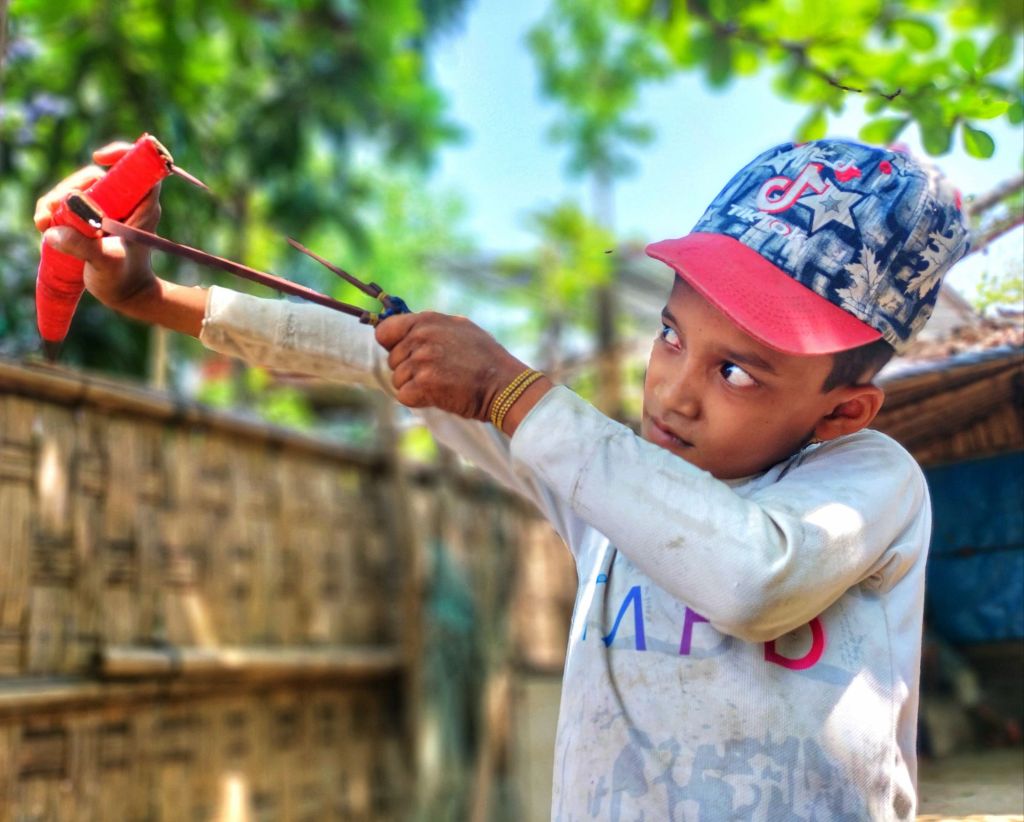
Abu Kalam, a twelve-year-old boy, is the son of Abu Siddek and a student of Life Destination High School, living in Kutupalong Refugee Camp in Bangladesh. Even in a place where animals and birds are now rare, Kalam finds happiness holding a simple slingshot in his hand, pretending to shoot at birds as children once did back home.
Seeing the slingshot in Kalam’s hands pulls me into a deep flashback of Arakan. I remember our student days clearly. We used to gather together, imitating hunters, and travel toward the mountains. Each of us carried a slingshot, our hearts filled with excitement as we aimed at birds under the open sky.
Those were magnificent days. Rohingya youths would go on picnics, sharing food, laughter, and stories after hunting birds. The simple slingshot brought us joy, peace, and unity, strengthening our bonds with one another and with nature.
Though Abu Kalam is still young, he carries within him the memories of a life he barely lived. Through his innocent play, he revives the lost traditions and simple joys of Rohingya life in Arakan, memories that refuse to fade, even in exile.
Photo captured during Rusana shared her journey crossed the endless struggle in Myanmar
The conflict between the Arakan Army (AA) and the Myanmar military junta has created a deadly trap, one in which Rohingya families are forced to suffer, flee and fight for survival. Among them is 19-year-old Rusana, a newly married young woman whose life was torn apart when her husband, Shohid Alam was abducted and killed by the AA.
Rusana, daughter of Mohammed Islam is from MaungNi village (မောင်နီရွာ) in Maungdaw, Arakan State. At just 16, she married Shohid Alam of Paddang village (ပဒင်ကျေးရွာ) in Southern Maungdaw. Shohid was educated, optimistic and determined to build a better future for their family. Their happiness grew with the birth of a baby boy with joy in the middle of rising unrest.
As fighting intensified between the AA and the military junta, nights became sleepless and homes unsafe. “Hoping to escape brutal attacks, we moved to my parents’ house in MaungNi village,” Rusana said.
Weeks later, on 21 July 2024, during Eid-ul-Adha, Shohid traveled to his native village to meet his brother, recently released from Buthidang Jail after unjust imprisonment during the 2017 crackdown. Many Rohingya, including Shohid had been jailed or sentenced without reason and clear evidence of deliberate persecution.
Shortly after leaving, Rusana received a devastating phone call.
“I was told that my husband along with six others was arrested by the Arakan Army while returning to me. Later, we learned they were killed.” Rusana cried through broken tears
By August 2024, AA artillery assaults targeted Rohingya villages. Rusana’s family fled to Ali Para, seeking temporary safety. But ten days later, the AA captured more than 1,000 people including her family and forcibly gathered them in Pan Taw Phyin village.
They eventually returned to Paddang but arrests of young men became constant. Fearing for their lives, Rusana’s father arranged for the family to cross the Naf River into Bangladesh.
On 15 August 2024, after a dangerous journey, they reached the Bangladesh border. But instead of safety, they were met by gangs of boatmen. “They searched us and took our valuables and even forced me and one of my sisters to be naked. They took 1.5 million MMK and 8.5 ticals of gold hidden in our clothes.” Rusana recounted, “During this abuse, the men in our group were locked away in a dark room.”
With help from a compassionate guide, Rusana and her family eventually reached a relative’s shelter in a refugee camp. Although they escaped immediate danger, new struggles began regarding food shortages, lack of healthcare, insecurity, trauma and the pain of losing Shohid.
Like Rusana, there are many unresearched victims who lost their belongings and family members under the attack of Arakan Army AA. The silence of the world is the dely of justice and peace on Rohingya Muslims in Arakan State in Myanmar.
My name is Sayedul Amin, son of Kamal Hossain and Noor Foraz. I am 17 years old and one of nine members in my family. I was a student in Kyet Yoe Pyin (ကြက်ရိုးပြင်), Northern Maungdaw Township, Arakan State, Myanmar. Life was simple and peaceful, closely tied to nature. I was in grade 2 when I was still in Myanmar. Though our life was small, our hopes were big.
But how could we ever imagine that we would be forced to search for safety from a land that had suddenly become a graveyard, destroyed by the brutal operations of the Burmese military?
On 11 October 2016, my life changed forever when the junta began its campaign of discrimination and violence. It all started on 9 October, when an armed operation began moving from Hawarbil village (ကျီးကန်ပြင်) toward our village, Kyet Yoe Pyin. On that day, some of my neighbors were killed by gunfire, young and old, without distinction. Others were taken by Burmesesoldiers, and to this day, there is no news of them. Tears became our closest companion. Fear flowed like a stream. Our land became venomous, yet hope still lived in our hearts.
On 12 October 2016, we made the painful decision to leave our home. I felt like a motherless child. “Where will we go?” my father asked through tears. No one wanted to leave, but we had no choice. We left behind everything—our belongings, our memories with carrying only fear in our hearts and a faint hope for survival.
That night, we reached a house not far from our village. We spent the whole night hearing gunfire, like rain falling on our fears and the mosquitoes were only night guards. The next morning, the military began going door to door. We hid in silence. The soldiers shouted, “Where are you? Come fight us!” Our hearts felt like they were breaking into pieces, like a landslide falling into sand. We silently wept. Everyone prayed, “Oh Allah, Oh Allah.” After about an hour, the soldiers moved to another home. As soon as they left, we escaped.
Behind us, houses began to burn. Nearly 1,500 homes were destroyed in our village, including the market. We moved from village to village, desperately searching for safety. Gunfire echoed from the north. Everyone took shelter in the paddy fields and under the open sky. As we ran, the cries of the people and the sounds of bullets followed us.
A small stream with a strong current blocked our path. In the grief struck like an earthquake, I lost sight of my parents and other family members. I didn’t know how to swim. My heart broke again. Luckily, a villager heard my cries and helped me cross.
On 15 October 2016, I reached Kya Gon Ton village (ကျားခေါင်းတောင်ရွာ), where by some miracle, I found my family again. But the villagers there were also filled with fear and sorrow. My father, crying as he hugged me, said, “This is the end of my life.”One of my uncles suggested us to ahead to the mountains for safety. But soon, another idea gave us more hope, “It’s better to move to Bangladesh.” He added.
So we began our journey. Along the way, we were hungry, exhausted, and afraid. When we finally reached the border, gunfire broke out again. We were forced to stay one night near the border. That night, grass became our bed, leaves became our food, and melted dew became our water. Mosquitoes were our only companions and their relentless buzzing kept us awake. Many people died that night. I thought: “This stream is their grave, and the fish are now their friends.”
At dawn, we crossed the border into Bangladesh, paying 25,000 MMK per person with the money my parents had saved back home. On 22 October 2016, we reached our final destination: the Rohingya refugee camp in Bangladesh.
Now, I live as a refugee without home, land, or happiness. I am like a fish without water. A baby without a mother. A bird without a nest and the shelter I sleep in at night is full of mosquitoes and doesn’t allow me a peaceful sleep. I don’t have access to higher education. Sadness is my closest friend in the camp. Yet despite everything, I continue my studies. I currently study in grade 9 at Life Destination High School in Camp 6. I am trying to build a better future, InshAllah (God willing).
My final request to the world is this: Please open your eyes to the Rohingya crisis. Bring us justice. And ensure that Rohingya children like me—have the chance to access higher education.
Note:
Sayedul Amin, a grade 9 students, begins sharing his life struggle through his pen after receiving the recent Beginning Writers’ Workshop organized by Life Destination High School.
My name is Abul Kayes, and I was born on July 2, 2002, in a village called Yea Mea Toung, nestled in the green hills of Northern Maungdaw, in Arakan State, Myanmar. My family is big with my parents, four brothers, eight sisters, and me. We lived a life of simplicity and closeness, where love was stronger than hardship. My father, Nur Korim, now 73, is a man of deep thought and quiet strength. My mother, Sara Khatun, now 48, is the heart of our home, resilient, selfless, and full of courage.
Our village was more than a place. It was a world. I remember waking up to the sounds of birds and the smell of fresh rain within the romantic scene as I felt like a prince in a kingdom made of bamboo, sunlight, and family.
But on 25 August 2017, when I was just 15, everything changed. The sound of gunfire from the Burmese military thundered over the skies like crashing icebergs, shattering the calm and scattering our world into trauma. I remember the fear before I understood the reason. Rumors of violence spread like wildfire: soldiers were coming. Villages were burning. People were disappearing. And then, it came to us. That night, none of us could sleep. All of my parents’ remaining belongings including jewelry were buried under the ground for safety. My mother held onto 500,000 MMK, but it didn’t last. Some of it was spent during our escape, and the rest was given to the poor as an act of generosity even in hardship. My father quickly reached out to his brother, Habib Ullah, who supported us by sending 100,000 MMK after selling fish from my father’s lagoon.
One night, under a moonless sky, we packed whatever we could carry that were some rice, clothes, and food. Before leaving, we fed our cows and pets, hoping they’d survive without us. But they didn’t touch the food. They seemed to know. We cried as we walked away from everything we had ever known.
On 27 Aug 2017, we made our way to Kyet Yoe Pyin ( ကြက်ရိုးပြင် ) where one of my sisters lived. Her family joined our escape. Along the way, we lost Jesmin, my sister, in the chaos. She had run ahead. It took hours to find her in a nearby village. By then, our home had burned to ash.
We moved another village called Kiyan Bong where we took shelter but sometimes we needed to sleep beside the village, in the paddy fields and hidden inside the bushes because the fear of Militaries’ gunshots didn’t allow to stay at proper place or sleep. My mother had cooked Qurbanimeat for Eid just the day before we fled. “It is our last proper meal as a family.” My mother said with tear.
We again reached Shil Khali village. I remember carrying 2–3 kilograms of rice and the last 2,000 kyat we had. I bought onions and chilies from a nearby shop. Jesmin made a thin soup that warmed our empty stomachs and tired souls.
On 3 Sep 2017, we crossed the Naf River into Bangladesh, but a new challenge awaited us. The boats were too small to carry our entire family together, so I and one of my brothers boarded one boat, while the rest of our family, including my parents, were placed on another.
During the crossing, the crew on our boat took everything we had important documents, supplies, and personal belongings. It was a cruel moment when we were already at our most vulnerable. Thankfully, the rest of the family had managed to carry 100,000 MMK which my Uncle sent to my parents and paid the fare for their boat.
We arrived on the other side with exhausted, broken, and afraid hearts. But then something unexpected happened. The Bangladeshi people welcomed us with kindness. They gave us water, food, and shelter. For the first time in weeks, we felt the warmth of human compassion again.
Jesmin got lost once more in Hansur Para, a village in Bangladesh, waiting on the roadside. When we finally found her, we smiled. It was the first smile I’d seen on my parents’ faces since we left Myanmar. We stayed there for three days, then moved to Kutupalong Refugee Camp in Cox’s Bazar, now the largest refugee settlement in the world. My eldest sister’s husband paid the 2,500Tk for our transport. It wasn’t easy, but we were safe.
My parents, even in their grief, encouraged me to keep studying. I enrolled in informal classes and managed to complete Class 10 while living in the camp. It was not just about education and it was survival. Learning became my rebellion.
My mother, with almost nothing, found ways to support me. She sold lentils, rice, and potatoes, earning barely 500 taka a month, just enough for pens and notebooks. Her hands were worn, but her faith was unshaken. ” You don’t need to be afraid of your study is being lost till I am alive.” She encouraged me
I also studied Arabic and Urdu on my own. I wanted to speak with dignity, to write with power. Every new word I learned felt like reclaiming something the world tried to take from us.
When I was 16, I met a man named Soyed Korim. He told me to write a CV, a simple piece of paper that would change my life. I applied for a job, and by the mercy of Allah, I was hired as a Case Management Volunteer with CODEC on November 6, 2019.
It was the first time I felt I had a role in the world again. Since then, I’ve worked to help other refugees, children like me, families like mine, who lost everything but hope. Life is still hard. Our salaries are small. We fall sick often. But we are human, and we still dream. We still believe
This story is not just mine. It is the story of the Rohingya people, a story of sorrow, strength, and survival. We were born in a storm, but we are not broken.
“Hope grows in the soil of pain. And education is the light that breaks through the darkness.”
My parents once dreamed I would become a surgeon. Today, I dream of studying at Stanford University. I don’t know what tomorrow holds. But I know that I will keep learning. I will keep helping. I will keep dreaming. of Because we may be refugees in the eyes of the world. But in the eyes of Allah, we are not forgotten.
Note:
Abul Kayas recieved the recent writing workshop and begins writing on real stories including his own one.
We are proud of seeing our Beginning Writer’s Workshop is playing an essential part of growing too many talents.
This photo is taken while Abu Siddek making the basket by using his skills
Abu Sidek, a 67-year-old Rohingya refugee, lives in Kutupalong, Camp-2W, Bangladesh. With over 20 years of experience in traditional craft-making, he has relied on his skills to survive after losing everything when he fled Myanmar in 2017.
Life in Myanmar
Before being displaced, Abu Sidek lived a stable life in Myanmar with his wife and five children. He owned two acres of farmland, a herd of cattle, and made handcrafted items like baskets, cradles, fishing nets, and barns. His craftsmanship supported his family, paid for his children’s education, and helped two of them get married.
Forced to flee
In 2017, military operations forced him to leave everything behind and seek refuge in Bangladesh. In the crowded refugee camp, he had no land, no cattle, and no home—but he still had his craft-making skills. He continued making baskets and other handmade items to earn a living.
Struggle and moving forward
By 2022, his remaining children had married, leaving him and his wife to live alone. Despite the challenges, he remained dedicated to his craft. However, in 2023, his wife passed away, leaving him in deep sorrow. Determined to move forward, he remarried, seeking companionship and support. His new wife takes care of the household while he continues crafting. Each basket takes him a day to complete, requiring two bamboos costing 50 TK each. He sells them for 200 TK, providing enough to sustain their daily needs.
A message of hope
Many Rohingya refugees have lost everything and struggle to find hope. Abu Sidek encourages them to keep going and use whatever skills they have to build a future. He also calls on the international community to support the well-being and dignity of the Rohingya people. Through his craft, he continues to find purpose, proving that resilience can help overcome even the hardest times.
Moriyam, a 15-years old Rohingya girl and a dedicated student at Life Destination High School, is a genocide survivor who left her country and fled to Bangladesh due to harassment, torture, gang rape and brutal discrimination conduted by the Burmese Military force on 2017.
Even though, the unbearable challenge and struggle she had faced in Refugee camp, Bangladesh, she preserved and eventually joined with our Life Destination High School. The outstanding teaching and guidance of her teachers inspired her to develop a passion for learning through the Burmese Curriculum. This passion pushed her dream of pursing higher education including University studies.
In June 2024, the school received a remarkable opportunity from the Asian University for Women ( AUW ), offering a scholarship to a deserving student so called Moriyam. Empowered by the school committee, Moriyam applied to the scholarship and performed well in the interview. With a good fotunate and determination, she secured this opportunity, opening the door of her luck and a more beautiful journey in her future studies.
Her teachers in Life Destination School are incredibly proud of her acheivement. They continue praying for her success and believe she will one day become a cornerstone of her Rohingya community.
Following the independence of Myanmar, Rohingya fought government forces in an attempt to have the mostly Rohingya populated region around the in northern Arakan (present-day Rahkine State) gain autonomy




 Life Destination School